
Free case study: How we generated $104M in pipeline in 8 weeks for a $5B+ B2B SaaS company
This was not more outbound. This was more thinking before outbound.

Most B2B SaaS companies don’t have a targeting problem.
They have a reason-to-care problem.
Execs are already busy. The already have tools. They already have their priorities.
Usually warm or cold outbound just creates more activity around weak reasons to act.
A few months ago, we helped launch a different motion with a $5B+ B2B SaaS company.
The goal was not to ask reps to “do more outbound.”
The goal was to help reps think better about their customers’ businesses, form specific deal hypotheses, turn those hypotheses into them-first offers, and create buyer agreements RevOps could actually inspect.
Here’s what happened.
The scoreboard
We started with an account cohort of 3,542 accounts.
From there, we helped the team estimate where the largest value opportunities might exist, prioritize the accounts worth pursuing, and guide reps through a repeatable deal-creation motion.
The scoreboard looked like this:
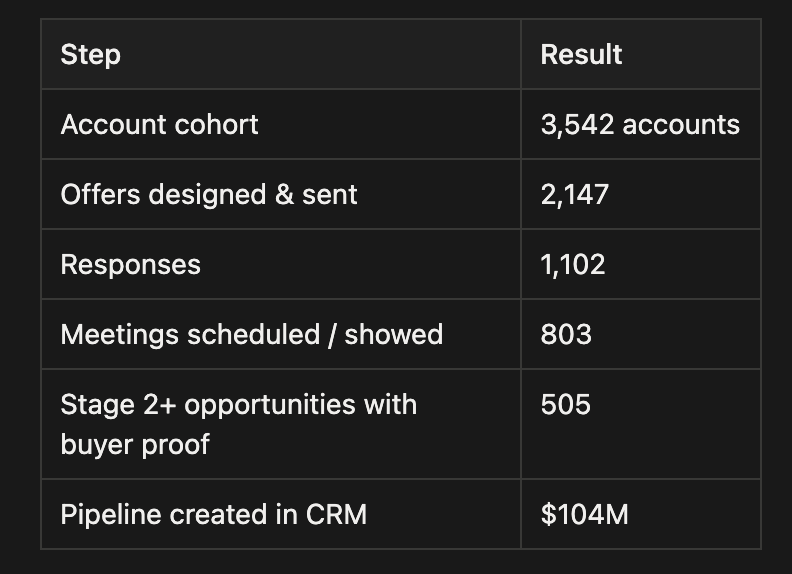
The number is nice.
The more important part is how it was created.
Because this was not a spray-and-pray outbound campaign.
This was not a “personalize the first line and hope” motion.
This was not reps being told to send more emails, make more calls, or add more activity to an already noisy system.
This was a simple path:
Account → customer objective → customer gap → customer pain → deal hypothesis → them-first offer → champion attention → buyer agreement → RevOps-certified pipeline.
That path matters.
Because pipeline is not real just because a rep creates an opportunity.
Pipeline gets real when the buyer agrees to something that makes the deal more real.
Phase 1: We stopped treating the account list like a to-do list
Most account lists are just disguised wish lists.
Big logos. Good fit. Right industry. Existing whitespace. Some intent signal. Maybe a relationship somewhere.
Fine.
But a good account is not a good deal.
The first move was to look at the account cohort and ask a better question:
Where could we create enough value that a buyer would actually care?
Not:
Who can we send to?
But:
Where might there be a real business improvement we can help create?
That is a different level of thinking.
For each account, the team looked for clues:
What is this company trying to accomplish?
Where might they be constrained?
What initiatives are they already talking about?
What business gap might make our solution relevant?
What value could we plausibly help create?
Who inside the account would care if this worked?
That gave the reps something better than a target account.
It gave them a testable deal hypothesis.
And that is where the motion started to change.
A rep is much more useful when they are not just saying:
“Here’s what our product does.”
But instead:
“Here’s what we think may be happening in your business, here’s the outcome we think may matter, and here’s why it might be worth pressure-testing.”
That is not more outbound.
That is more thinking before outbound.
Phase 2: We turned product pitches into them-first offers
The second move was offer redesign at the account level.
Most outbound starts from the seller’s world.
Our product. Our platform. Our latest feature. Our customer story. Our meeting request.
Buyers do not wake up hoping to learn about your SKU.
They wake up thinking about their world.
Revenue. Cost. Risk. Speed. Execution. Board pressure. Forecast confidence. Customer retention. Strategic priorities.
So the offer had to move from us-first to them-first.
An us-first offer sounds like:
“We help companies use our platform to improve account planning and sales execution.”
A them-first offer sounds more like:
“We think there may be a way to turn a specific set of your strategic accounts into qualified pipeline by building buyer-specific value hypotheses around the initiatives your customers already care about. Worth pressure-testing on a few accounts?”
That is a different ask.
It is not asking the buyer to care about your category.
It is asking them to inspect a business hypothesis.
That is why the response rate changed.
Across the motion, reps sent 2,147 offers and generated 1,102 responses.
Not because every message was magical.
Because the messages were built around the buyer’s business instead of the seller’s product.
The best outbound does not feel like outbound.
It feels like someone did enough homework to have a useful point of view.
Phase 3: We turned attention into buyer agreements
Getting attention is not the same as creating pipeline.
This is where a lot of outbound motions break.
The buyer responds.
The meeting happens.
The rep does discovery.
Maybe there is a demo.
Maybe there is a follow-up.
Then the opportunity either gets created too early or quietly disappears.
We wanted the motion to be more inspectable than that.
So the rep was guided through a simple flow:
What account are we pursuing?
What objective does that account likely care about?
What gap might be blocking them?
What pain does that create?
What deal hypothesis are we testing?
What is the next buyer agreement to make this more real?
That last question is important.
Not just:
“Did we get a meeting?”
But:
“Did the buyer agree to anything that makes the deal more real?”
A real buyer agreement might be:
agreement that the problem exists
agreement that the impact is meaningful
agreement to bring in another stakeholder
agreement to review a value hypothesis
agreement that the account should move into a Stage 2+ opportunity
agreement that the next step will answer a specific business question
That is how the pipeline became visible, controllable, and coachable.
RevOps could audit it because the proof lived in the CRM fields.
Managers could coach it because they could see where the deal was weak.
Reps could improve it because they knew the next buyer agreement they were trying to earn.
That is very different from “just do more outbound.”
Why it worked
The motion worked because it changed the unit of work.
The unit of work was not:
Send more emails.
The unit of work was:
Create a better reason for this buyer to act.
That is the whole difference.
The team was not just creating meetings.
They were creating deal hypotheses.
They were not just pushing product.
They were translating product into customer outcomes.
They were not just asking reps to be busy.
They were making pipeline quality visible enough to coach weekly.
That is what most revenue teams are missing.
They can see activity.
They can see stages.
They can see forecast categories.
But they cannot always see the actual quality of the deal being created.
Does the buyer understand the pain?
Does the buyer believe the value?
Does the buyer agree to the next step?
Does RevOps have proof?
Does the manager know what to coach?
That is what this motion made visible.
The bigger lesson
If you are short $100M in Stage 2+ pipeline your reps can actually close, the answer is probably not “more outbound.”
Its likely better deal creation.
Better account thinking.
Better deal hypotheses.
Better them-first offers.
Better buyer agreements.
Better proof in CRM.
More outbound is easy to ask for.
Better pipeline is harder to build.
But it is also much more useful.
So if your team is busy, your sequences are running, and your pipeline still feels fragile, I would ask:
Are we creating more activity, or are we creating better reasons for buyers to act?
That question will tell you a lot.
And if you are $100M short in Stage 2+ pipeline that your reps can actually close, this is the kind of motion we can help stand up with you.
We help your team identify the right accounts, build deal hypotheses, create them-first offers, guide reps toward buyer agreements, and make the pipeline visible enough for RevOps and managers to coach weekly.
And we prefer to get paid when the outcomes show up.
Rooting for your customers,
Carson